DoorDash Is Buying Instacart, and Your Delivery Apps Will Notice
The DoorDash and Instacart deal is signed, not a rumor. Here is what the paperwork confirms, why it landed now, and who stands in the way.
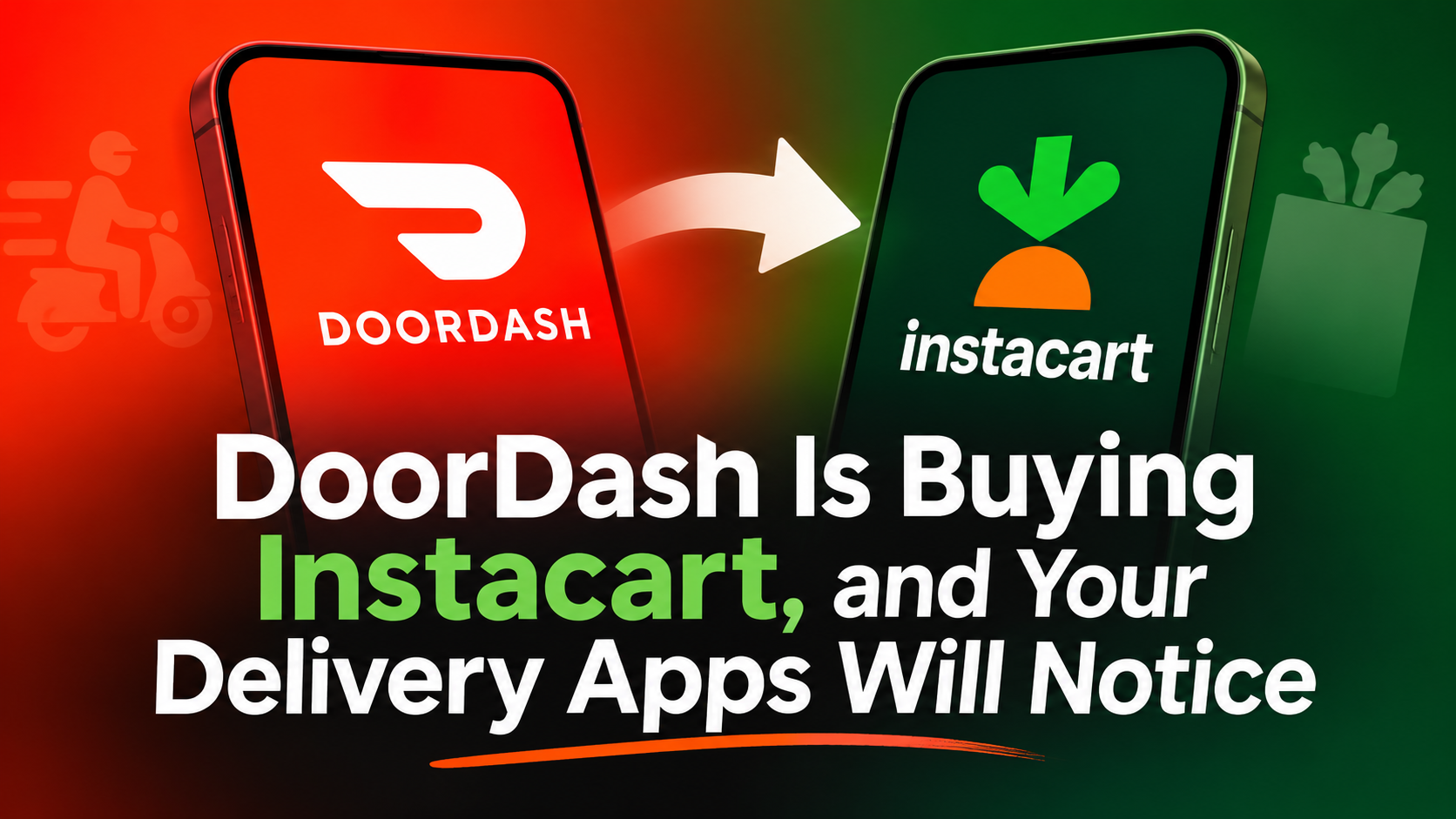
You know the routine: one app for tonight's takeout, another for the weekly grocery run, and two memberships quietly billing you each month. That routine is about to get a single owner. DoorDash has agreed to buy Instacart, an equity value of about $17 billion, and this is not a rumor.
Our take: the deal is more likely to hurt competition than help you, because it removes the independent rival best placed to keep fees honest.
Two caveats come with the headline number. The $17 billion is not an all-cash price, since up to 25% of the payment is DoorDash stock. And the deal has not closed yet, with the companies aiming to finish sometime between late 2027 and mid-2028.
What the paperwork says
Yes, and the proof is in regulatory filings rather than gossip. The merger agreement is dated October 28, 2026, and the companies announced it the next day. Under its terms, DoorDash's merger subsidiary, Ibiza Merger Sub, Inc., merges into Maplebear Inc. (Instacart), which survives as a wholly owned DoorDash subsidiary.
The timing tells its own story. DoorDash's most recent quarterly filing mentioned the proposed acquisition only in passing, with no price or terms. The earlier filing excerpt shown does not mention it at all.
The cash side is backed by a JPMorgan bridge loan commitment of up to $13.0 billion, with no financing condition on closing. One more thing to read carefully: the filing says its summary of the agreement is incomplete and that its representations should not be treated as statements of fact. It also sets aside DoorDash's promises to grocers, merchants and consumers when judging whether regulators have inflicted a material harm on the deal.
Even the premium depends on the date you pick. The offer is 26% above Instacart's close before sale reports surfaced, but CNBC puts it at a much slimmer margin over the day before the announcement.
Why now? Slower growth and a walked-away Uber
Start with DoorDash's growth, which looks better than it is. Third-quarter orders grew 28%, but that includes the Deliveroo purchase; without it, growth was noticeably slower. Buying Instacart is another route to growth once the organic kind slows.
The two companies also arrived from opposite directions. Instacart pioneered app-based grocery shopping done by independent shoppers, while DoorDash began with restaurants and moved into groceries. They were bound to collide.
Instacart, for its part, picked its moment. Bloomberg previously reported that it held talks with Uber and walked away. TechCrunch's view is that Instacart saw a good time to sell before grocery competition stiffens. The companies themselves point to big retailers building their own fleets, memberships and AI shopping assistants.
Investors were split on the day: DoorDash shares jumped, while Instacart traded near flat.
By the numbers
- 59%: DoorDash's share of US delivery app spending in the third quarter, up from 44% in Q2 2021, grocery and restaurants combined.
- 18%: Instacart's roughly current share of that spending, down from 26% in 2021.
- 338 million: orders Instacart completed last year, against more than 3 billion at DoorDash.
- $13.0 billion: the most DoorDash can draw from its JPMorgan bridge loan.
- $1,250,000,000: what DoorDash owes Instacart if antitrust conditions sink the deal.
- $650,000,000: what Instacart owes DoorDash if it accepts a superior proposal.
Who's on the board, and who's watching
Instacart's board approved the deal unanimously. Holders of about 19% of its shares, including D1 Capital Partners and Sequoia Capital Operations, have already signed on to vote yes.
This is part of a pattern, not a one-off. DoorDash completed its Deliveroo purchase in October 2025, and NBC notes that Uber owns Postmates and a Delivery Hero stake. DoorDash now runs the DoorDash, Wolt and Deliveroo marketplaces, so adding a North American grocery platform would extend a group that already spans regions. The direct competitive effect stays in North America, though global rivals such as Uber Eats and Delivery Hero shape the logic.
Regulators are the main obstacle. Closing needs Hart-Scott-Rodino clearance, plus Canadian and Israeli approvals. The FTC could review the deal under the Clayton Act standard, and the agency is already considering rules on add-on charges from delivery apps. Instacart's $60 million FTC settlement in December 2025, over misleading users and subscription enrollment, will color that review. DoorDash's own filing admits approvals could come with conditions that hurt the combined company.
What it means for your cart, your courier and your corner grocer
Start with what DoorDash is promising you. DoorDash expects Instacart shoppers could reach more than 50,000 additional stores, and that one membership would replace two. The company estimates the merged membership would save members $100 million a year in fees. Spread across every member, that is small, and the companies have not said what the combined membership will cost, so one higher fee could erase it.
DoorDash also argues that scale helps customers, and points to its own results. It says DashPass growth helped cut transaction fees per order in US restaurants by 9% over two years. Those are company claims, and a restaurant result may not carry over to groceries. Meanwhile DoorDash expects to put more than 100% of its projected savings from the deal back into the business in the first year after closing, so early savings would not show up as lower prices.
Couriers have the most to lose quietly. Instacart's roughly 600,000 shoppers would keep choosing their assignments and could get more DoorDash work. But antitrust attorney Ethan Litwin notes the two companies are often two of the three biggest buyers of shopper labor, so workers lose a bidder.
Grocers get a pledge, and a worry to go with it. DoorDash says they can use any delivery platform, with no exclusivity, and that Instacart's tools could help smaller stores build websites and ad networks to compete with Walmart and Amazon. It is a company promise, and how it would be enforced is unclear. The big-rival argument has weight, since Walmart leads US grocery with a 21% share. Even so, DoorDash controlling Instacart's technology could let it cut off rivals or watch their pricing, antitrust attorney Ethan Litwin warns.
What should you do right now?
Probably nothing, for a long while. Until closing, the two companies operate as separate and independent businesses. Perks, including card benefits, could change later if the Instacart brand is folded in, so the useful habit is to read any notice about membership terms when it arrives.
Ask yourself a few questions: do you pay for both memberships, and would one combined fee beat keeping your favorite? Do you rely on stores that only Instacart serves? Cancel nothing now, but check your renewal dates and keep any change notices.
Our take: good for the deal, not for the market
Our take: the deal is more likely to be bad for competition than good for users. DoorDash is already the biggest player in delivery app spending, and buying Instacart removes an independent rival best placed to keep fees honest. Bundle discounts will be real but temporary.
The strongest counter-argument is that Instacart has been shrinking, and Walmart and Amazon loom large. A weakened Instacart may not be a durable check on DoorDash, and a blocked deal could leave it to be sold to Uber, which it already talked to once. That is a fair point about the future, but it is an argument for watching a sale to Uber, not for waving this one through, because workers and grocers face the same fewer-buyers problem either way.
The review will be slow. The FTC's pricing inquiry and Instacart's settlement make a clean approval harder, and the expected closing window of late 2027 to the first half of 2028 suggests the companies anticipate a drawn-out process. The cash fee DoorDash would owe Instacart if regulators sink the deal points the same way.
We see two paths. In one, a lengthy second request or a challenge ends in abandonment and that fee, most likely if the FTC treats grocery delivery as its own market with DoorDash and Instacart as the leading two. In the other, the memberships merge after closing, promotions run for a while, then fees and merchant ad costs creep up. Watch for a second request, state attorneys general joining in, the price of the combined membership, minimum order rules, and whether the Instacart app survives.
Sources 14sec.gov, Instacart, TechCrunch and 11 more sources
- sec.gov (Oct 29, 2026). DoorDash, Inc. - Form 8-K - FY2026
- Instacart (Oct 29, 2026). DoorDash to Acquire Instacart to Help Local Stores Win
- TechCrunch (Oct 29, 2026). DoorDash to acquire Instacart for $17B. Aisha Malik
- foodnavigator.com (Oct 30, 2026). DoorDash’s Instacart deal promises CPG better ad reach, raises antitrust concerns. Timothy Inklebarger
- Yahoo Finance (Oct 29, 2026). DoorDash to buy Instacart for $17 billion creating a home delivery giant for everyday goods. Brittney Donovan
- sec.gov (Oct 28, 2026). Maplebear Inc. - Form 425 - FY2026
- Upgraded Points (Oct 29, 2026). DoorDash Will Buy Rival Instacart in a $17 Billion Deal. Nick Ellis
- sec.gov (Oct 26, 2026). DoorDash, Inc. - Form 10-Q - FY2026
- CNBC (Oct 29, 2026). DoorDash to acquire Instacart for $17 billion
- NBC News (Oct 29, 2026). DoorDash to acquire Instacart for $17 billion, creating delivery giant. Rob Wile
- Yahoo Finance (Oct 30, 2026). DoorDash's $17 billion Instacart deal raises new warning for shoppers. Aparajita Chatterjee, Celine Provini
- sec.gov (Feb 9, 2024). DoorDash, Inc. - Form 10-K - FY2023
- Yahoo Finance (Oct 30, 2026). DoorDash CEO Says $17B Instacart Deal Will Make Grocery Delivery Faster And Cheaper; FTC Scrutiny Looms. Shivani Kumaresan
- Law Commentary (Oct 30, 2026). DoorDash to Buy Instacart for $17 Billion, Raising Antitrust Concerns. Xiolene Lozano
Last updated 2 Nov 2026. This article draws on reporting and data from these sources; links in the text point to the most important ones.
Comments
No comments yet. Be the first to say what you think of this post.