Spacefast Puts a Live Link on Whatever Your AI Builds
Automattic's Spacefast publishes sites and apps made with ChatGPT, Claude or Cursor. Here is where it came from, what its plans include, who it suits and what remains unproven.
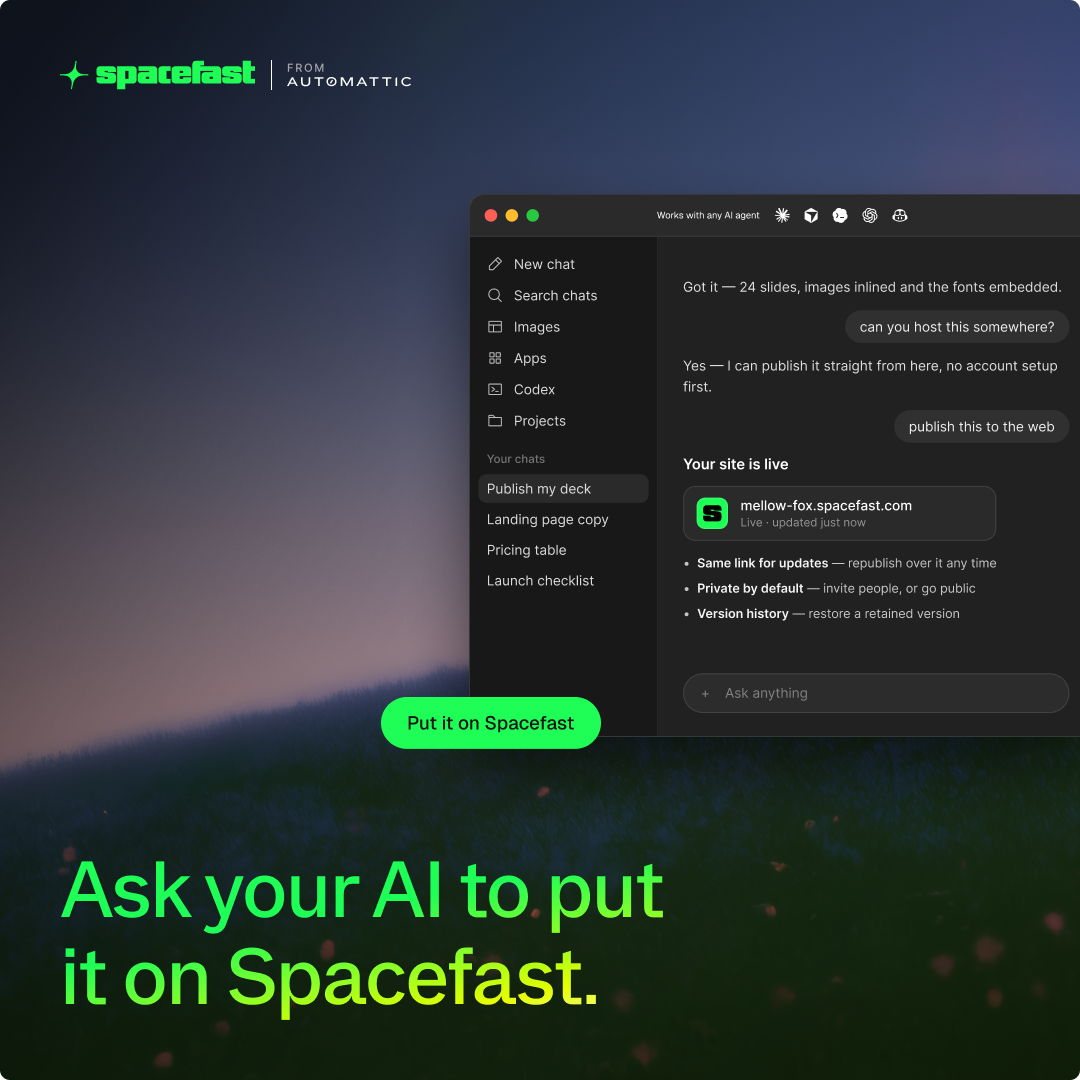
Spacefast lets people publish whatever an AI tool made to a live link, no account needed for a first try. An unclaimed Space even carries a countdown: it expires 33 hours and 20 minutes after it is created or last changed.
Automattic, the company behind WordPress.com, opened it to everyone in November 2026.
Spacefast supplies what AI-generated projects usually lack: a database, user logins, file uploads, email and analytics. Our claim is that its importance lies less in those features than in the attempt to make publishing the default last step of AI building, and we think that is the part to watch. The evidence is thin, because most of what we know comes from the company.
It started with friends who kept sending Vercel links
The idea began during Radical Speed Month, when Automattic builders paused their pre-AI roadmaps and made whatever they wanted for a month. Batuhan İçöz, then working on the Beeper messaging app, kept getting GitHub and Vercel links from non-technical friends who wanted to share their AI-built projects. He wanted a simple way to host those creations, so he started with a static hosting service.
That project was first called Stattic and was later renamed Spacefast. When the month ended, Automattic's VP of Product asked İçöz whether he would go full time on it, which is why a side project became a separate effort.
A soft launch came around Sept. 22 and 23, 2026, and Matt Mullenweg said it landed the day before an Automattic board meeting. A documentation change from the same period already sketched Free, Go and Plus pricing, though it described it as upcoming.
Then it became its own company
On Nov. 9, 2026, Automattic announced Spacefast as its own company and opened it to everyone the same day. İçöz, who came to Automattic through its acquisition of Texts, is its founder and CEO. The press release says he built the first version alone.
His title varies from outlet to outlet, from project builder to lead to CEO. Our read is that his role may have grown with the project after the spin-off, though nothing we have seen confirms it. Ownership details of the independent company are not public.
Automattic is leaning on its own plumbing to make the new company credible. Spacefast runs on WordPress.com infrastructure, which Automattic says serves more than 15 billion page views a month.
You bring the AI, they bring the plumbing
Spacefast builds nothing itself and describes itself as a publishing and hosting layer for whichever AI you already use. There is no built-in chat box. The agent gets build instructions and a database, and the result lands on a private link where teams can comment.
There are several ways in: from an AI chat, by dragging a folder or zip, by connecting a Git repo or through a command line. Spacefast connects to ChatGPT, Claude, Claude Code and Cursor, among others.
Each Space comes with a MariaDB database, plus a CDN, DDoS protection, bot detection and spam checks. Every publish saves a version you can restore, with permanent links to old ones. Spaces are private by default, and you can add a password, invite people or make them public, so a non-technical builder controls who sees the work.
It is not a new WordPress, even though each Space runs a hidden WordPress install on Automattic's wp.cloud infrastructure. Think of it as a deployment and operations layer, next to a host such as Vercel rather than a CMS.
What the three plans give you
The company's own pricing page is the best reference, so use its numbers, since early coverage differed. The free personal plan needs no card, allows commercial use and includes 20 Spaces and 20 custom domains. Go costs $5 a month and raises that to 100 Spaces and 100 domains, with hourly database backups and a choice of datacenter.
The paid tiers are built as a ladder, and each rung adds room and team features. The $15 tier brings 500 Spaces and 500 domains, team roles, wildcard domains and up to five free members. Enterprise is custom-priced and adds SSO, SAML and SCIM. Each paid plan bundles usage credit equal to its monthly fee.
Launch coverage does not match the pricing page, so check the page before comparing plans. Coverage called Go unlimited and listed storage and team-size limits that the page never mentions.
The real cost question is what happens when the credit runs out, because the pricing page does not state overage rates. Spacefast charges for infrastructure rather than AI credits, which is why the free allowance is small by design. To us the paid tiers look like on-ramps, and the true price will be set by overage rules that have not been published yet.
Who should try it, and who should look elsewhere
The stated core user is a non-technical person who made something with ChatGPT or Claude and wants a live link. Early adopters have used it for internal mockups, slideshows and promotional sites. Automattic also pitches it to companies whose marketing teams spin up landing pages on many outside services.
Against Lovable and Emergent, the contrast is positioning. Those two do not leave you free to pick your own model or tool, while Spacefast works with several. İçöz calls that flexibility its edge, though that comes from the company.
No price comparison with Vercel, Lovable or Emergent is available, so we rely on reasoning here. You still pay for your own AI subscription on top of Spacefast, and our read is that costs here will depend on how much your project needs. A static page or mockup carries little lock-in and suits the free tier, while an app that needs logins and a database ties you closer.
Our suggestion for the cheapest test: publish one existing AI-built project and one Git repo, then try restoring a version. Before that, ask which AI tool you will build with and whether the project needs a backend or only a page.
The catches: preview status, lock-in and keeping users
Spacefast is still in research preview, so features, limits and pricing can change. One hands-on tester found each scheduled run gets about five seconds, which forced his tracker to read one page per run. Built-in app authentication is also still coming, so private projects rely on a password or share link.
Portability is the other limit. Apps on Spacefast runtimes need code changes to move elsewhere, while static sites usually move as they are. The scale of that migration cost has not been disclosed.
The sharpest criticism is about retention. İçöz acknowledged that users often try new AI tools and then move on. We think this is the decisive test, since versioning, domains and databases give people reasons to stay.
Automattic presents deployment, rather than the WordPress content layer, as where value now sits. That fits one blogger's argument that most side projects die at deployment, when a demo works locally but is never shared. So if you have a demo sitting unshared, publishing it is the easiest way to find out whether you stay.
What happens next depends on Automattic as much as on Spacefast
Spacefast launched during turbulent months at Automattic, with executive changes, board restructuring and layoffs in October 2026. A big parent is reassuring, but nobody has published user numbers or funding details for the spun-off company yet.
The roadmap is ambitious, with email, storage, video, payments and WordPress integration all coming soon, so start small now and let the rest arrive. Our bet is a base case where Spacefast stays a niche but credible layer for non-technical builders, provided overage rates are published and the preview settles into stable limits. Until then, try it on a small project and hold off on committing anything big.
The downside is that integrated rivals keep the people who want one place to build and publish. Then Spacefast becomes a feature rather than a destination, a real risk and not a prediction. Watch whether AI tools add hosting of their own.
Spacefast's significance is distribution more than features. A large hosting operator is trying to make deployment a default step that AI chat tools can call directly, through plugins for Claude Code and ChatGPT. Before you commit, check the live pricing page.
Sources 11Spacefast, DEV Community, TechTimes and 8 more sources
- Spacefast. Spacefast: Home for what your AI makes
- DEV Community (Nov 10, 2026). Spacefast: A Home for the Apps Your AI Builds - DEV Community. Mohammad Hassan Amer
- TechTimes (Nov 10, 2026). AI App Hosting: Automattic Launches Spacefast So Claude and ChatGPT Can Publish Apps. Devin Culbertson
- Crypto Briefing (Nov 9, 2026). Automattic launches Spacefast to turn vibe-coded apps into live products. Diego Almada Lopez
- Webrazzi (Nov 10, 2026). WordPress'in sahibi Automattic'ten yeni vibe coding platformu: Spacefast. Tuğçe İçözü
- The CODEW (Nov 1, 2026). Automattic Launches Spacefast: Bringing AI-Built Websites and Apps Into Its Infrastructure Ecosystem - The CODEW. Erwin Castro
- Spacefast (Nov 9, 2026). Spacefast and beyond. Batuhan İçöz
- Swipeline (Nov 10, 2026). Automattic’ten yapay zeka ile geliştirilen uygulamalar için yeni platform: Spacefast - Swipeline. Serpil Ergül
- GitHub (Sep 22, 2026). Update plans and usage documentation by batuhan · Pull Request #49 · spacefast/docs · GitHub
- GitHub (Nov 9, 2026). Automattic, 'Spacefast' 출시 — 쓰던 코딩 에이전트 그대로, 만든 앱을 비공개 링크로 바로 올립니다 (11/9, Automattic 공식) · Issue #3887 · roomedia/ax-trend · GitHub
- Emergent (Nov 9, 2026). Automattic Launches Spacefast for Vibe Coding Deployment
Last updated 11 Nov 2026. This article draws on reporting and data from these sources; links in the text point to the most important ones.
Tools for this

Lovable
AI app and website builder that turns plain-language descriptions into working full-stack software.
Mentioned in this post
ChatGPT
AI chat assistant that answers questions, writes, creates images, runs deep research and helps with code.
Mentioned in this post

Cursor
AI coding agent and editor that plans, writes and reviews code on the desktop, in the terminal and in the cloud.
Mentioned in this post

Vercel
Cloud platform for deploying web apps and AI agents, with an AI gateway, sandboxes, workflows and a global CDN.
Mentioned in this post

Claude Code
Anthropic's AI coding agent that plans, edits code, runs tests and opens pull requests from your terminal or IDE.
Mentioned in this post
Comments
No comments yet. Be the first to say what you think of this post.