
Factory
Agent-native software development platform whose Droids plan, build, review and ship code across desktop, CLI and web.
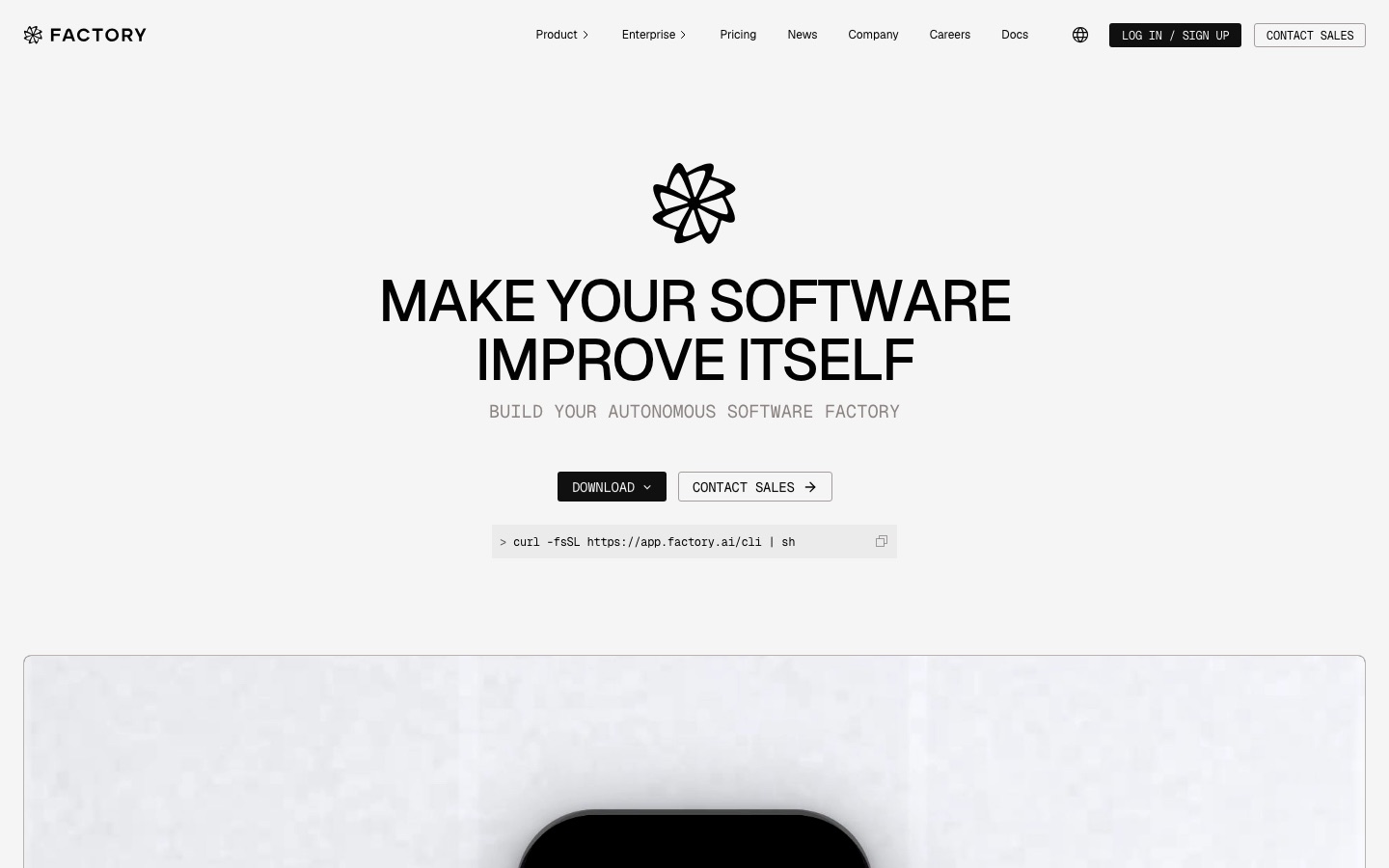
Factory is a software development platform built on autonomous coding agents called Droids. Factory's agents plan a change, write the code, review pull requests and validate the result, working from a desktop app, the terminal, the web or a CLI. Engineering teams set goals and policies, then follow progress in Mission Control and usage in analytics.
Best for Engineering teams that want coding agents to carry out planned changes, reviews and routine automation under central usage and policy controls.
- Platforms
- Web
- Pricing model
- Subscription
- Made by
- Factory
- Added
Last verified: . Information taken from factory.ai.
What is Factory?
Factory is a software development platform built around autonomous coding agents called Droids. The agents take a goal, plan the change, write and validate the code, and can run from a desktop app, the terminal, the web or a command-line tool, either locally or as background jobs in the cloud. Around the agents Factory adds management tooling: Mission Control for watching active work and execution logs, automations for recurring engineering tasks, pull request review with inline comments, AutoWiki for repository documentation that updates with the code, and analytics that report adoption and consumption per developer and team. Model routing sends each task to a suitable model, and the company says it supports frontier and open-weight models from several providers. Plans run from individual Pro, Plus and Max tiers to Teams, Business and Enterprise, the last with on-premise deployment options.
Key Features
Droids
Coding agents that plan a change, implement it and validate the result while the team defines goals and policies.
Mission Control
A live view of running missions, the progress of each worker and detailed execution logs.
Code Review
Reviews each pull request and leaves inline comments on problems before the merge.
AutoWiki
Generates a wiki for every repository and keeps it in step with code changes.
Model Routing
Chooses a model per task by weighing cost, speed and output quality.
Analytics and Agent Readiness
Reports usage per developer and team, exports the data and scores how prepared each repository is for agents.
Screenshots
Use Cases
- Automating Routine Engineering Work
- Hand recurring chores to agents that plan, execute and check the work on a shared context.
- Reviewing Every Pull Request
- Add an automated review pass that comments inline before a human reviewer looks.
- Keeping Repository Docs Current
- Let the wiki regenerate as the codebase changes so newcomers can find their way around.
- Measuring AI Adoption
- Track which teams use the agents and how much they consume.
- Deploying in Regulated Environments
- Use single sign-on, audit logs, zero data retention and on-premise options on the higher tiers.
Things to know
- Usage scales with the tier
- Plus is described as roughly five times the usage of Pro and Max as roughly ten times.
- Teams is capped at 10 seats
- The Teams plan is meant for small groups; larger organisations are directed to Business or Enterprise.
- Cloud computers start at Plus
- Droid Computers, the Factory-managed cloud machines for remote agents, are listed from the Plus plan upward.
- Security features sit in higher tiers
- SSO, zero data retention and audit logs appear in Business, and on-premise deployment in Enterprise.
FAQs
What is Factory?
Factory is a platform for agent-driven software development. Its agents, called Droids, plan, write, review and validate code.
What is Factory used for?
Factory is used to delegate coding tasks, pull request review, repository documentation and recurring engineering automation to AI agents, and to monitor that work.
How much does Factory cost?
Factory lists Pro, Plus, Max, Teams, Business and Enterprise plans. See the official pricing page for current figures; Business and Enterprise are arranged with sales.
Where does Factory run?
Factory runs on desktop, in the terminal, on the web and through a CLI, and its Pro plan also mentions an SDK. Agents can work locally or in the cloud in the background.
Which AI models does Factory support?
Factory says it supports leading frontier and open-weight models, naming recent GPT-5, Claude Opus, Claude Sonnet and Gemini versions.
Does Factory have a plan for teams?
Yes. The Teams plan gives a small team shared, centralised billing for up to 10 seats, and Business and Enterprise cover larger organisations.
What enterprise controls does Factory offer?
Factory's Business tier lists SSO, SAML/SCIM provisioning, zero data retention, audit logging and admin controls. Enterprise adds data residency, sub-organisations and on-premise deployment options.
Who it's for
- Software engineers
- Engineering teams
- Engineering leaders
- Startups
- Enterprises
Comments
No comments yet. If you have used Factory, tell other readers how it went.
Alternatives to Factory
| Tool | Free plan | Starting price | API |
|---|---|---|---|
 CursorAI coding agent and editor that plans, writes and reviews code on the desktop, in the terminal and in the cloud. |
Yes | — | — |
 AgentSkill.shDirectory and marketplace of installable skills for AI coding agents such as Claude Code, Cursor and Copilot. |
— | — | — |
 Command CodeTerminal coding agent tuned for open models that learns a developer's coding preferences from accepted and rejected edits. |
— | — | Yes |
 DevinAutonomous AI software engineer from Cognition that plans, writes, tests and reviews code and opens pull requests. |
Yes | — | Yes |
 GreptileAI code review agent that indexes a repository and comments on pull requests with whole-codebase context. |
Yes | — | — |
Listed in the same categories as Factory. A starting price appears only where we checked it on the maker’s pricing page; a dash means not checked or not published. All AI Code Assistant tools