
Pl@ntNet
Citizen science app that identifies plant species from photos and turns shared observations into biodiversity data.
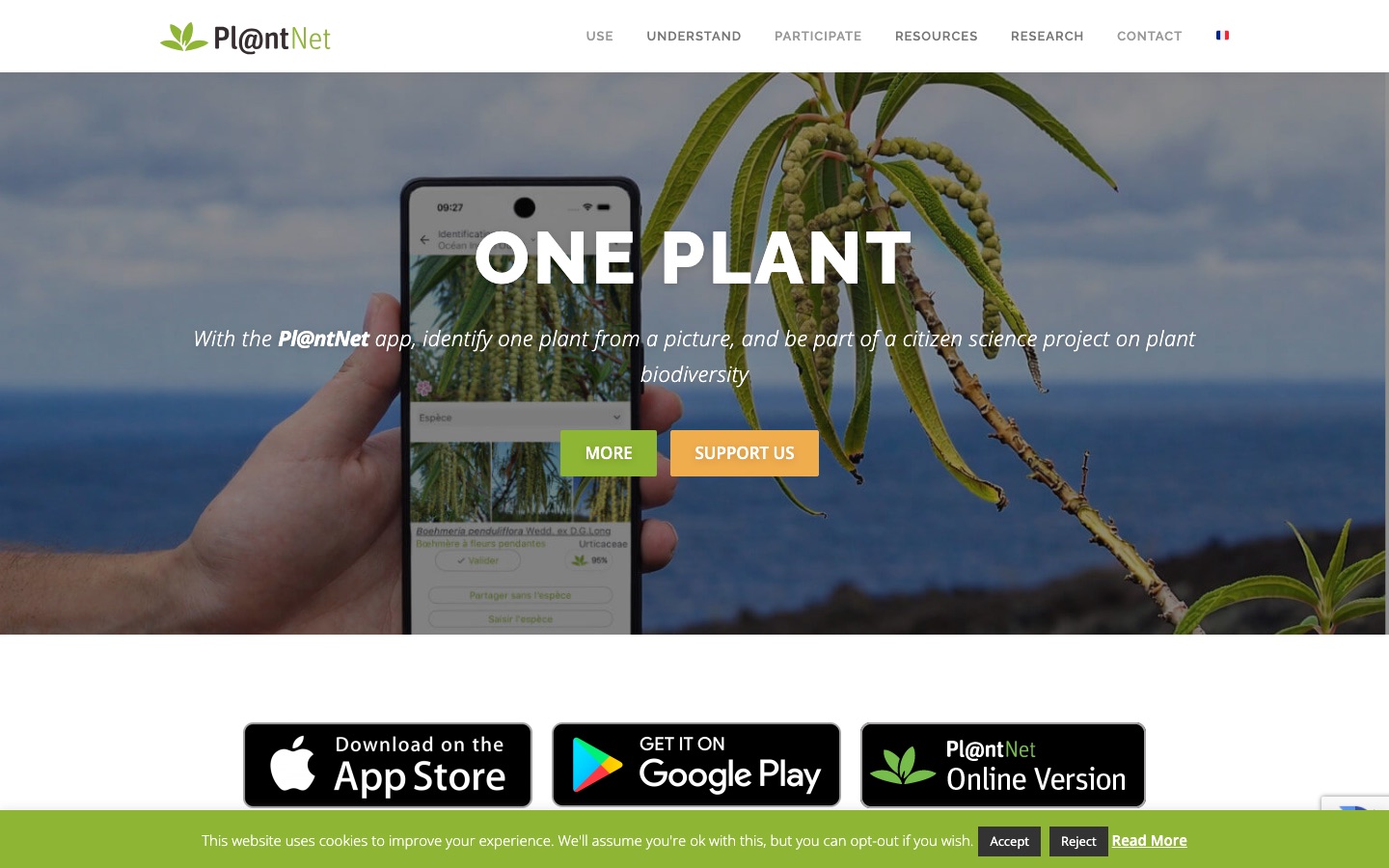
Pl@ntNet is a citizen science project delivered as an app that recognises plant species from photographs. A user takes or uploads a picture, Pl@ntNet suggests the species, and the observation can be shared so that it supports research on plant biodiversity. Pl@ntNet is available on mobile and the web and offers an API.
Best for Anyone who wants to name a plant from a photo, and researchers or developers who want to work with large-scale plant observation data.
- Platforms
- Web, iOS, Android, API
- Pricing model
- Free
- Free plan
- Yes
- API
- Yes
- Made by
- CIRAD, INRAE, Inria and IRD
- Added
Last verified: . Information taken from plantnet.org.
What is Pl@ntNet?
Pl@ntNet is a plant identification system built as a citizen science project. Its core is image recognition: you photograph a plant and the app compares the picture with its reference collection to propose a species. What separates it from a simple lookup tool is the community layer. People can create an account, submit their observations, review identifications made by others and work in groups, and the validated observations become data for biodiversity studies. The site counts more than 84,000 species and well over a billion images. Alongside the mobile apps there is an online version, an API for developers, open datasets published through channels such as GBIF, and a research programme with European projects. A feature for diseases and pests helps identify threats to crops. Pl@ntNet is funded partly by donations, which the team says keep it open and free.
Key Features
Photo Identification
Proposes a plant species from a single picture taken or uploaded by the user.
Shared Observations
Lets account holders submit what they find so the record can be used in biodiversity research.
Collaborative Review
Opens identifications to checking by other contributors, which improves the quality of the data.
Projects and Micro-Projects
Organises the flora by geography or theme, such as the USA or useful plants, with smaller-scale micro-projects as well.
Diseases and Pests
Identifies threats affecting a crop when a plant starts to decline.
API and Open Data
Gives developers programmatic access and publishes datasets, including Pl@ntNet 300k and data shared with GBIF.
Use Cases
- Naming a Plant on a Walk
- Photograph an unknown flower or tree and get a likely species.
- Contributing to Science
- Share observations that feed studies of where plant species occur.
- Checking Crop Health
- Use the diseases and pests feature to find out what is affecting a plant.
- Teaching Botany
- Have students identify local plants and review each other's observations in a group.
- Building on Plant Recognition
- Call the API to add species identification to another application or study.
Things to know
- Funded by donations
- The project runs donation campaigns and says the support keeps the service open and free.
- Observations become research data
- Sharing a plant observation makes it part of a citizen science dataset used in biodiversity work.
- Protected trademark
- The name and logo are a protected trademark of CIRAD, INRAE, Inria and IRD, and the site prohibits their use without permission.
- Professional services exist
- The contact form includes a category for professional services under the my.plantnet name.
FAQs
What is Pl@ntNet?
Pl@ntNet is a citizen science project and app that identifies plants from pictures and collects observations for biodiversity research.
What is Pl@ntNet used for?
Pl@ntNet is used to find out which species a plant belongs to from a photo, and to contribute observations that scientists can study.
Is Pl@ntNet free?
Yes. The Pl@ntNet team asks for donations in order to keep the platform open and free to everyone.
Does Pl@ntNet work on mobile?
Yes. Pl@ntNet is offered as a mobile identification app, with App Store and Google Play links on its home page, and there is also an online version.
Does Pl@ntNet have an API?
Yes. Pl@ntNet lists an API and a GitHub presence in the developers section of its site.
Who is behind Pl@ntNet?
The Pl@ntNet trademark is owned by four French research organisations: CIRAD, INRAE, Inria and IRD.
How many species does Pl@ntNet cover?
The Pl@ntNet home page shows a count of 84,710 species and about 1.48 billion images at the time of checking.
Who it's for
- Hikers and gardeners
- Students
- Botanists
- Researchers
- Farmers
- Developers
Comments
No comments yet. If you have used Pl@ntNet, tell other readers how it went.
Alternatives to Pl@ntNet
| Tool | Free plan | Starting price | API |
|---|---|---|---|
 PhotomathMath help app that scans a problem with the camera and explains the solution step by step. |
Yes | — | — |
 APEUniPTE exam practice platform that scores speaking and writing answers with AI. |
Yes | — | — |
AimlabsAim trainer for FPS players with AI-personalised tasks, performance analytics and game-specific practice tools. |
Yes | — | — |
 Alfa PTEOnline PTE practice platform with AI-scored questions, mock tests and performance analytics. |
— | — | — |
 AnikoGamified SAT prep platform with a diagnostic, an adaptive study plan, practice tests and an AI tutor. |
Yes | — | — |
Listed in the same categories as Pl@ntNet. A starting price appears only where we checked it on the maker’s pricing page; a dash means not checked or not published. All Image Recognition & OCR tools