

Consensus
AI academic search engine that finds and analyses peer-reviewed research papers and summarises what the evidence says.
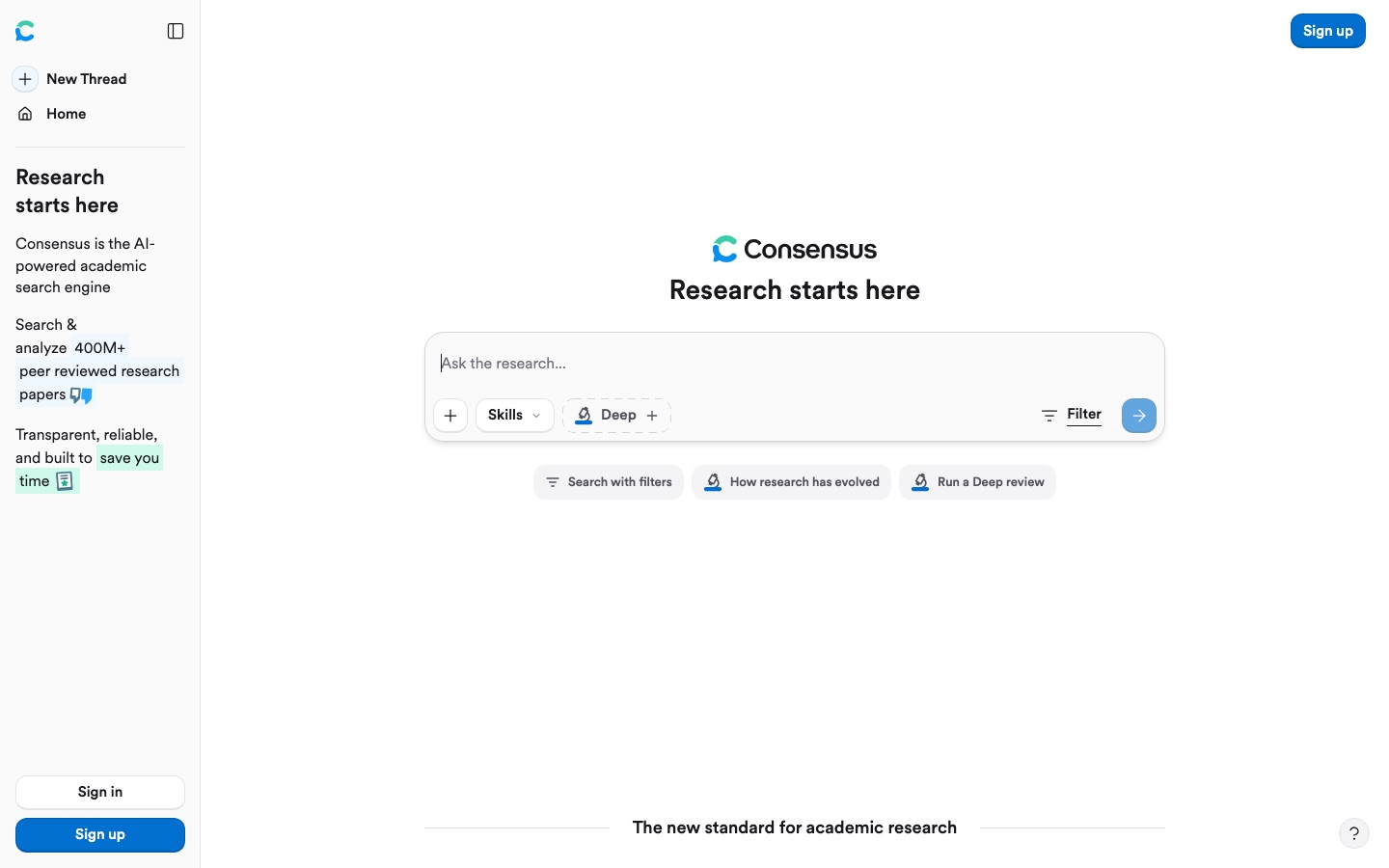
Consensus is an AI academic search engine for peer-reviewed literature. Consensus answers research questions from published papers, automates literature reviews with Deep Search, and shows how far studies agree through the Consensus Meter. Consensus is used in the browser by typing a question, optionally with filters for timeframe, population or study design written into the prompt.
Best for Researchers, students and clinicians who need answers grounded in published studies and a faster start on literature reviews.
- Platforms
- Web
- Made by
- Consensus
- Added
Last verified: . Information taken from consensus.app.
What is Consensus?
Consensus is an academic search engine that uses AI to search and analyse peer-reviewed literature. A question is typed in ordinary language and the answer is built from research papers; the site says its index runs to hundreds of millions of papers and includes full text licensed from publishers. Deep Search automates a literature review by drawing up a search strategy, widening key terms, pointing out conflicting arguments and following the citation graph. Medical mode limits results to clinical guidelines and articles from leading medical journals. Filters such as time period, population or study design can be written straight into the prompt and are applied automatically. For yes-or-no questions the Consensus Meter gives a visual reading of how far studies agree. Consensus says more than 170 university libraries provide access to students and staff, and that it serves around 10 million users.
Key Features
Research Paper Search
Answers a plain-language question from peer-reviewed papers instead of general web pages.
Deep Search
Builds a search strategy, expands terms, flags conflicting findings and explores citations to draft a literature review.
Consensus Meter
Shows at a glance how much the studies on a yes-or-no question agree or disagree.
Medical Mode
Restricts sources to clinical guidelines and articles from the top medical journals.
Natural-Language Filters
Reads conditions like sample size, timeframe or study type from the prompt and applies them to the search.
Licensed Full Text
Draws on full-text content licensed from academic publishers in addition to abstracts.
Use Cases
- Starting a Literature Review
- Run a deep search on a topic to map the main arguments and where they conflict.
- Checking a Claim
- Ask a yes-or-no question and see how the published evidence splits.
- Clinical Evidence Lookup
- Use medical mode to find guidelines and journal articles on a treatment question.
- Narrowing to Strong Studies
- Request only large human trials or controlled designs within the prompt.
- Tracing How Views Changed
- Explore how the research position on a subject has shifted over time.
Things to know
- Paper counts differ on the site
- The home page mentions both 250M+ and 400M+ papers; the exact size of the index is not stated consistently.
- Medical mode narrows sources
- Medical mode searches a defined set of clinical guidelines and top-journal articles instead of the full index.
- Institutional access
- Some users reach Consensus through a university library partnership.
FAQs
What is Consensus?
Consensus is an AI-powered academic search engine that finds, organises and analyses peer-reviewed research papers.
What is Consensus used for?
Consensus is used for literature reviews, checking what studies say about a question and finding papers by method or population.
How many papers does Consensus search?
Consensus cites figures of 250 million and 400 million papers in different places on its home page, so the index is in the hundreds of millions.
What is the Consensus Meter?
The Consensus Meter is a visual summary that shows how strongly the evidence agrees or disagrees on a yes-or-no research question.
What is Medical mode in Consensus?
Medical mode narrows Consensus results to roughly 8 million articles drawn from the 1,000 leading medical journals, together with about 50,000 clinical guidelines.
Is Consensus available through universities?
Yes. Consensus says over 170 university libraries partner with it to give students and faculty access, and it has pages for universities and organisations.
Can I filter Consensus results by study type?
Yes. Consensus lets you state timeframes, populations and study designs in the prompt and applies the matching filters automatically.
Who it's for
- Researchers
- Students
- Clinicians
- University libraries
- Science writers
Read about it

Used in these workflows
- Where AI tools fit in making a documentary, from research to subtitlesStage 1: Research and fact gathering
- AI tools for writing a research paper without handing over the thinkingStage 1: Finding the literature
Each guide lists the stages of one job and the tools that help at each stage. All guides
Comments
No comments yet. If you have used Consensus, tell other readers how it went.
Alternatives to Consensus
| Tool | Free plan | Starting price | API |
|---|---|---|---|
 AnswerThisAI research assistant that searches scholarly papers, verifies citations and drafts literature reviews. |
Yes | — | — |
 ElicitAI research assistant that searches academic papers and clinical trials, extracts data and writes cited reports. |
Yes | — | Yes |
JenniAI writing workspace for academic papers with source-grounded autocomplete, a reference library and citations. |
Yes | — | — |
 LinerAI search and research agents that give cited answers, find academic papers and draft documents. |
Yes | — | Yes |
 ThesisAIAI academic writing tool that drafts cited scientific documents of 8 to 80 pages from one prompt. |
— | — | — |
Listed in the same categories as Consensus. A starting price appears only where we checked it on the maker’s pricing page; a dash means not checked or not published. All Research & AI Search tools