Sony's ECM-W5 Is a Lock-In Play, and a Clever One
Sony's ECM-W5 records 32-bit float audio into the video file through the camera shoe, but only three bodies get the full trick. Here is who it suits, what it costs and where it falls short.
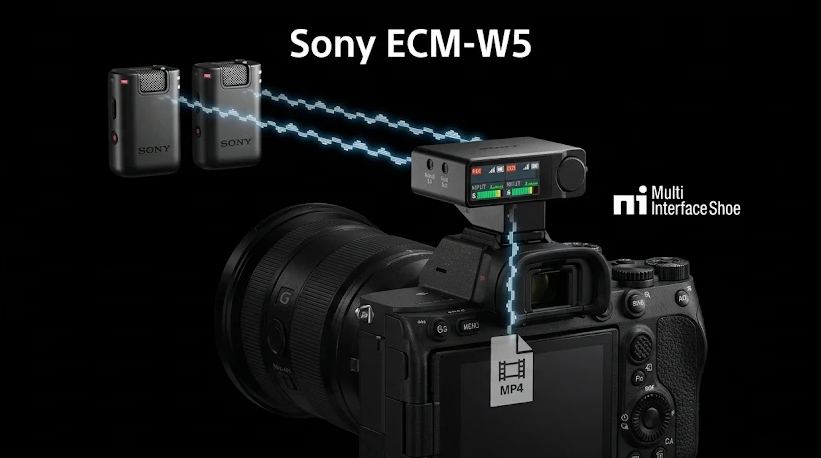
Sony's new ECM-W5 wireless mic kit costs $399.99, and the $259 DJI Mic 3 two-transmitter kit does most of the same job. What Sony adds is a trick no rival has: the audio travels through the camera's shoe and lands in the same file as the video. That one trick is the whole story, and it works only on certain Sony cameras.
Sony unveiled the kit on October 14, 2026, and the box holds a pair of transmitters, a single receiver and a charging case. In our read, the ECM-W5 is a lock-in play: it is worth its premium mainly if you own an A7 V, an A7R VI or an FX5.
For everyone else it is a pricey wireless mic with some nice extras. Reported prices for the kit and its add-ons vary a little between outlets, so treat the round numbers here as close, not exact.
The shoe does the work, and that is the point
The receiver snaps straight onto a camera's Multi Interface Shoe and passes 32-bit float audio to the body digitally. Sony says a compatible camera stores that sound inside the video file, so you skip the external recorder and the syncing afterward.
The shoe also carries power, so a compatible Sony camera can run the receiver and one battery drops off your list. With linked power control, the receiver and transmitters switch on with the camera. Cameras without the shoe fall back to a 3.5 mm cable into the receiver, and the receiver also works with phones and computers over USB-C.
The catch is which cameras can store float natively: three current bodies, the Alpha 7R VI, the Alpha 7 V (with firmware v2.00 or later) and the Cinema Line FX5. More than 20 other Sony bodies receive the digital audio but record it in their own internal format.
Float is a safety net, not magic
Float is a safety net more than a feature you will use every day. It stores such a wide range of levels that quiet and loud passages can be rescaled later without riding the gain, which suits run-and-gun interviews where voices jump around. TechRadar's reviewer says most people will not need it day to day, but calls it useful in unpredictable places.
Float cannot rescue everything: if the signal clips at the microphone input stage, lowering the volume in editing will not bring it back. The manual gain range of -12 to +12 dB is fairly narrow.
Float also comes with a trade-off: it works only at 48 kHz, while the 96 kHz setting tops out at 24-bit. Before you shoot a paid job, test that your editing software and playback devices handle these files, because some play back too loud or silent.
Sony has been here before
The Multi Interface Shoe is a proprietary mount that Sony introduced in September 2012 with the α99. A digital audio interface joined it in 2020 on cameras like the α7C, which let mics skip analog conversion.
The W5 follows the ECM-W3, announced in 2023, which already had a shoe-mounted receiver sending digital audio straight to the camera. That system leaned on a safety button that recorded a duplicate stream against clipping, while the W5 relies on float plus gain trim.
Why push this now? Float has moved from dedicated recorders into consumer wireless mics, and rivals already record it on their transmitters. Our bet is that Sony saw the gap and answered with the one thing rivals cannot copy easily: pulling float through the shoe into one file.
Is 'world first' fair? Only if you squint
TechRadar's reviewer calls the in-camera float a world first, and Tech Times says it is the first consumer wireless mic to route float through a camera's shoe. To us, the fair reading is narrow: it is not the first float recording, only the first consumer wireless mic to do it this way.
Rivals such as the DJI Mic 3 and Insta360 Mic Pro keep their float files on the transmitter, so you sync them in the edit. The DJI Mic 3 can also reach a Sony shoe through an optional adapter, but that link is capped at 24-bit. Videomaker agrees both DJI and RØDE already record float on board, and calls the shoe connection Sony's edge.
It costs more than DJI, less than Sony used to charge
The price gap with DJI is easy to state in either currency. The W5 kit is $399.99 or £350, against $259 or £215 for the DJI Mic 3 two-transmitter kit. Add-ons cost extra, and a replacement receiver is the pricey one at $190.
Against Sony's own past, the W5 looks friendlier, since the ECM-W3 launched in 2023 at $470. Back in 2023, Notebookcheck argued that the Rode Wireless PRO offered more features, longer range and float recording at a lower price.
On paper the W5 also wins on stats, with 64 GB of transmitter storage against the older system's 32 GB and a longer claimed range, both ideal line-of-sight figures.
The catches are real, and some are unanswered
Sony's full compatibility list was still marked as coming soon when the first reviews appeared, so buyers cannot yet confirm their body. Sony built the system mainly for its own cameras that have a compatible shoe and a digital audio interface. On non-float cameras, the float audio stays on the transmitter and needs syncing in post.
Handling is a weak spot: the receiver's touchscreen faces backward on the shoe, so settings are hard to change when you film yourself. Newsshooter found the transmitters rather large. TechRadar judged the noise reduction gentle and less effective than DJI and Insta360.
No 3.5 mm cable comes in the box, and Sony's press material gives no latency figure for its live-streaming pitch. Independent range and noise tests were still awaited. If you plan to use lavaliers, note that Newsshooter warned Sony's wiring may differ from common mics, with the Sanken COS-11 as an example.
Who should buy it, and who should walk past
The best fit is a creator on one of the three float-native bodies who shoots interviews or run-and-gun with unpredictable levels and wants a one-file workflow. Unlike the latest DJI mics, the Sony system supports external lavalier mics, which many broadcasters require, as Engadget notes. For Sony shooters whose cameras support the shoe features, it is the one to beat.
If you shoot Canon or Nikon, or want a cheaper kit, look elsewhere. DJI and RØDE offer broader compatibility across camera brands, while Sony's convenience comes at a premium. Engadget's Ian Carlos Campbell finds it hard to recommend over DJI unless you specifically want Sony cameras.
Setup is simple: clip the receiver onto the shoe, open the charging case to wake the receiver, and lift out the transmitters to power them on. Audio settings for digital-interface accessories live under Shoe Audio Set.
Where this is heading, and what would prove us wrong
We expect Sony to widen float support through firmware once the compatibility list appears, and prices to soften when rival stock and independent tests arrive. The 64 GB backup and external mic input make the W5 a safer pro-leaning tool, while the backward screen and gentle noise reduction hurt solo vloggers.
Rivals could answer with shoe or adapter integrations that carry float on other brands, but only if camera makers open their digital interfaces. Whether Canon or Nikon do is uncertain. A long compatibility list, with float on many more bodies, would weaken our lock-in verdict.
Before you buy, check the published compatibility list for your exact body, then wait for independent range and noise tests to show whether the float promise holds up.
Sources 17Digital Camera World, Videomaker, What Digital Camera and 14 more sources
- Digital Camera World (Oct 14, 2026). Sony's new wireless mic takes on the DJI Mic 3. Gareth Bevan
- Videomaker (Oct 16, 2026). New Sony ECM-W5 wireless mic records 32-bit float in-camera - Videomaker. Pete Tomkies
- What Digital Camera (Oct 15, 2026). Sony's new ECM-W5 wireless microphone records 32-bit float audio directly to camera - What Digital Camera. Heart Templado
- iTech Post (Oct 16, 2026). Sony Launches ECM-W5 Wireless Microphone Kit to Compete With DJI, Featuring 32-Bit Float Audio. Gio Farley
- Tech Times (Nov 1, 2026). Sony ECM-W5 Ships November 19 as First Wireless Mic With In-Camera 32-Bit Float Audio. James Whitaker
- Best Of High End (Oct 15, 2026). Sony ECM-W5: 1 Essential Wireless Mic for Creators. Marco Lisi
- CineD (Oct 15, 2026). Sony ECM-W5 Wireless Microphone System Announced. Johnnie Behiri
- Camera Jabber (Nov 5, 2026). Sony ECM-W5 wireless microphone price, specifications and availability announced. Ali Jennings
- redsharknews.com (Oct 14, 2026). Sony ECM-W5 wireless mic: specs and price. Andy Stout
- Newsshooter (Oct 14, 2026). Sony ECM-W5 Wireless Microphone System with Audio Recording - Newsshooter. Matthew Allard ACS
- TechRadar (Oct 16, 2026). I've reviewed the Sony ECM-W5 — it's a pricey wireless mic with a trick that no rival from DJI and Rode can match. Sam Kieldsen
- Engadget (Oct 14, 2026). Sony is taking on DJI with its new ECM-W5 wireless microphone kit - Engadget. Ian Carlos Campbell
- helpguide.sony.net. ILCE-7M5 | Help Guide | Audio accessories compatible with the Multi Interface Shoe. Sony Corporation
- Grokipedia (Jan 14, 2026). Multi Interface Shoe — Grokipedia
- Notebookcheck (Sep 29, 2023). Sony launches three wireless microphones for content creators: ECM-W3, ECM-W3S and ECM-S1 - NotebookCheck.net News. Vishal Bhardwaj
- No Film School (Oct 14, 2026). Sony’s Latest Wireless Microphone System Aims to Bring 32-Bit Float Recording Directly to Your Cameras
- Photography Talk (Oct 16, 2026). Sony ECM-W5 Wireless Mic Kit, Up to 11-Hour Transmitters, Ships in November. Sean Simpson
Last updated 11 Nov 2026. This article draws on reporting and data from these sources; links in the text point to the most important ones.
Comments
No comments yet. Be the first to say what you think of this post.