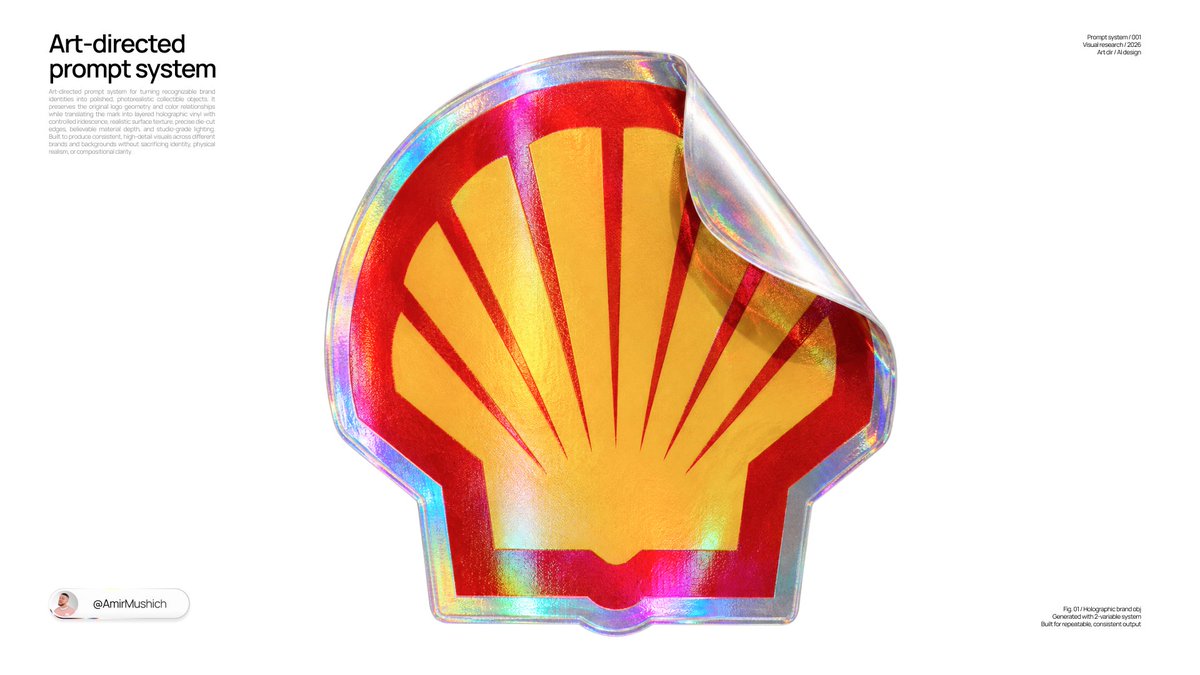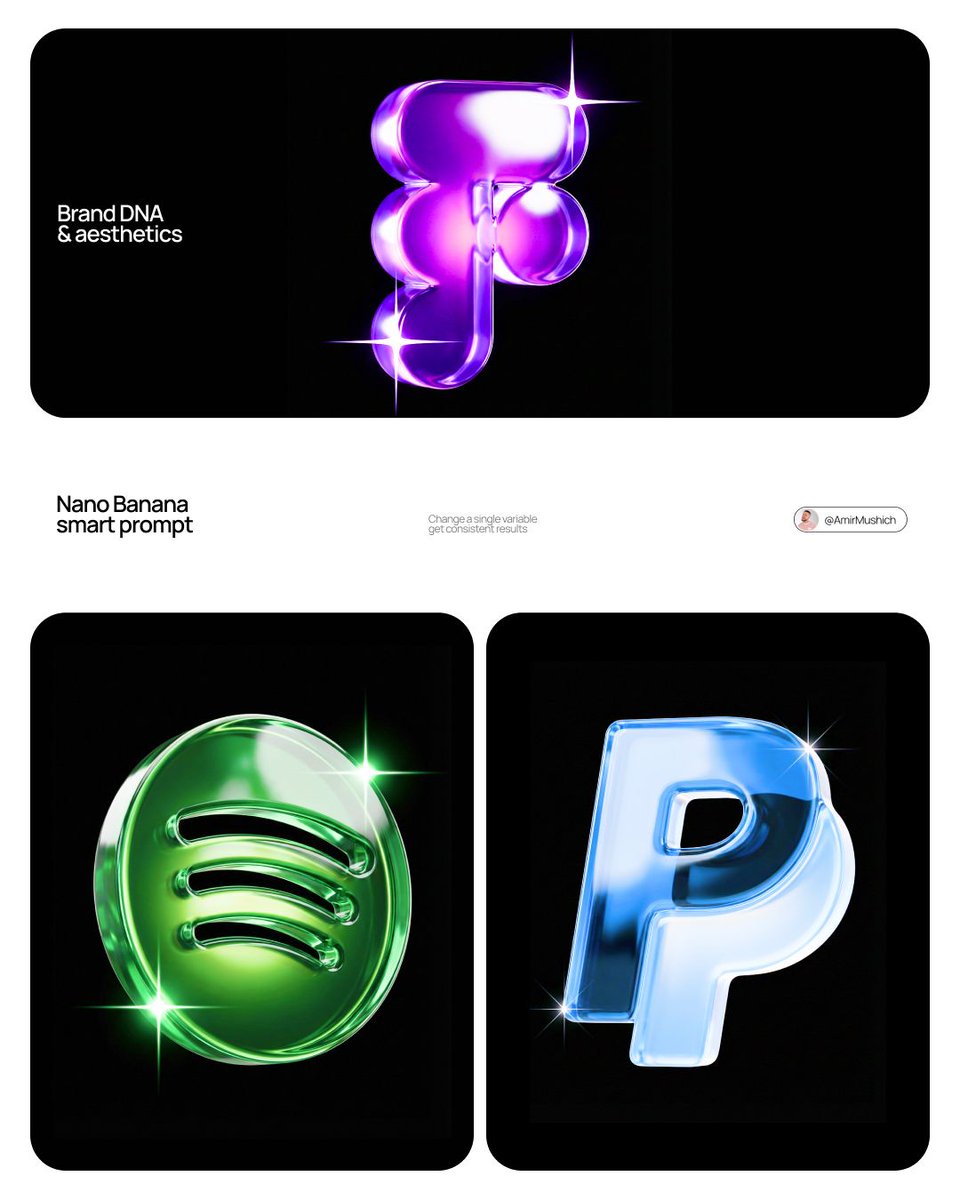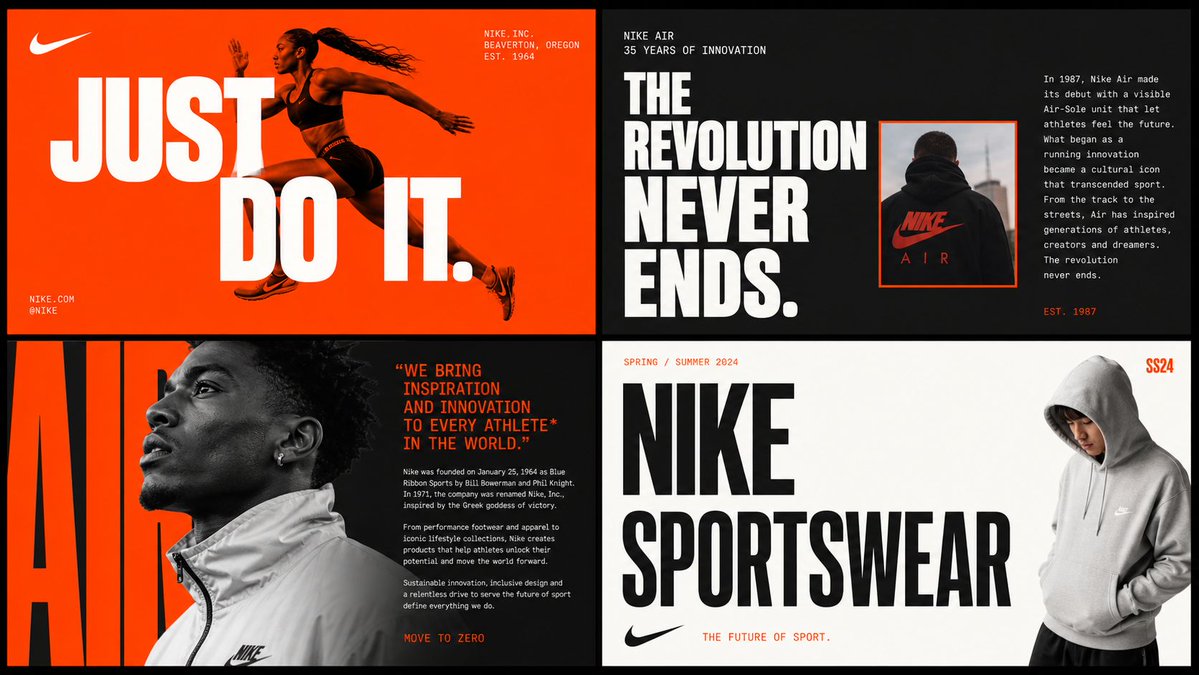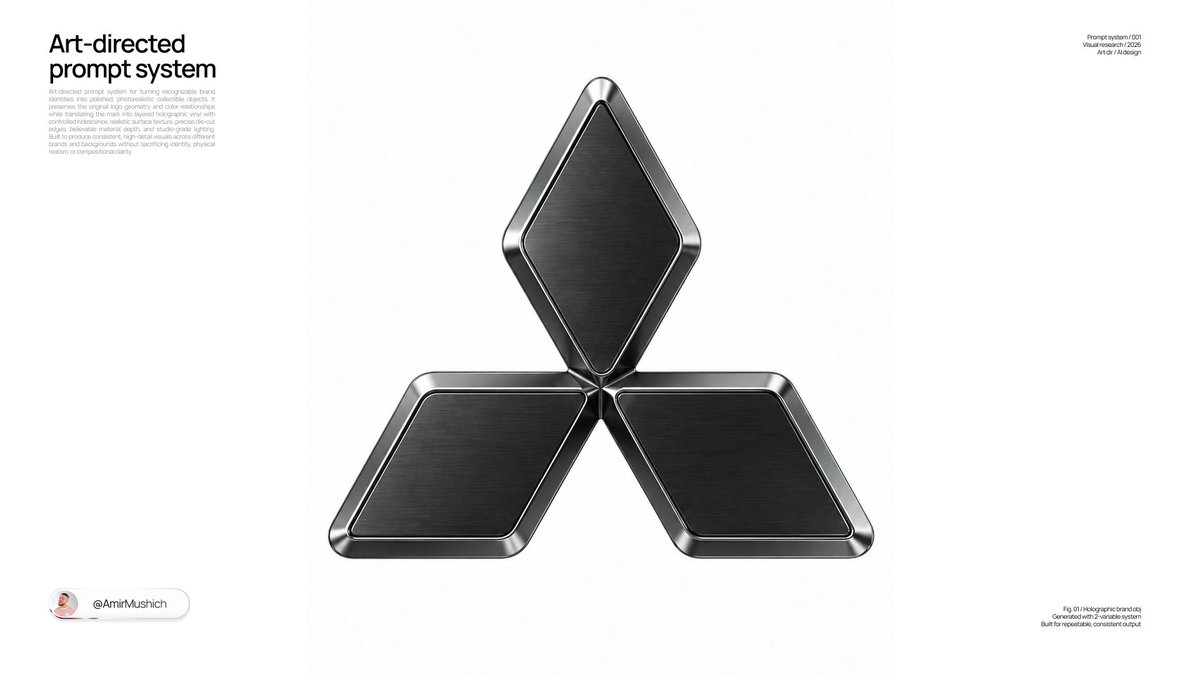
Prompt d'image Branding et UI Personnalisables
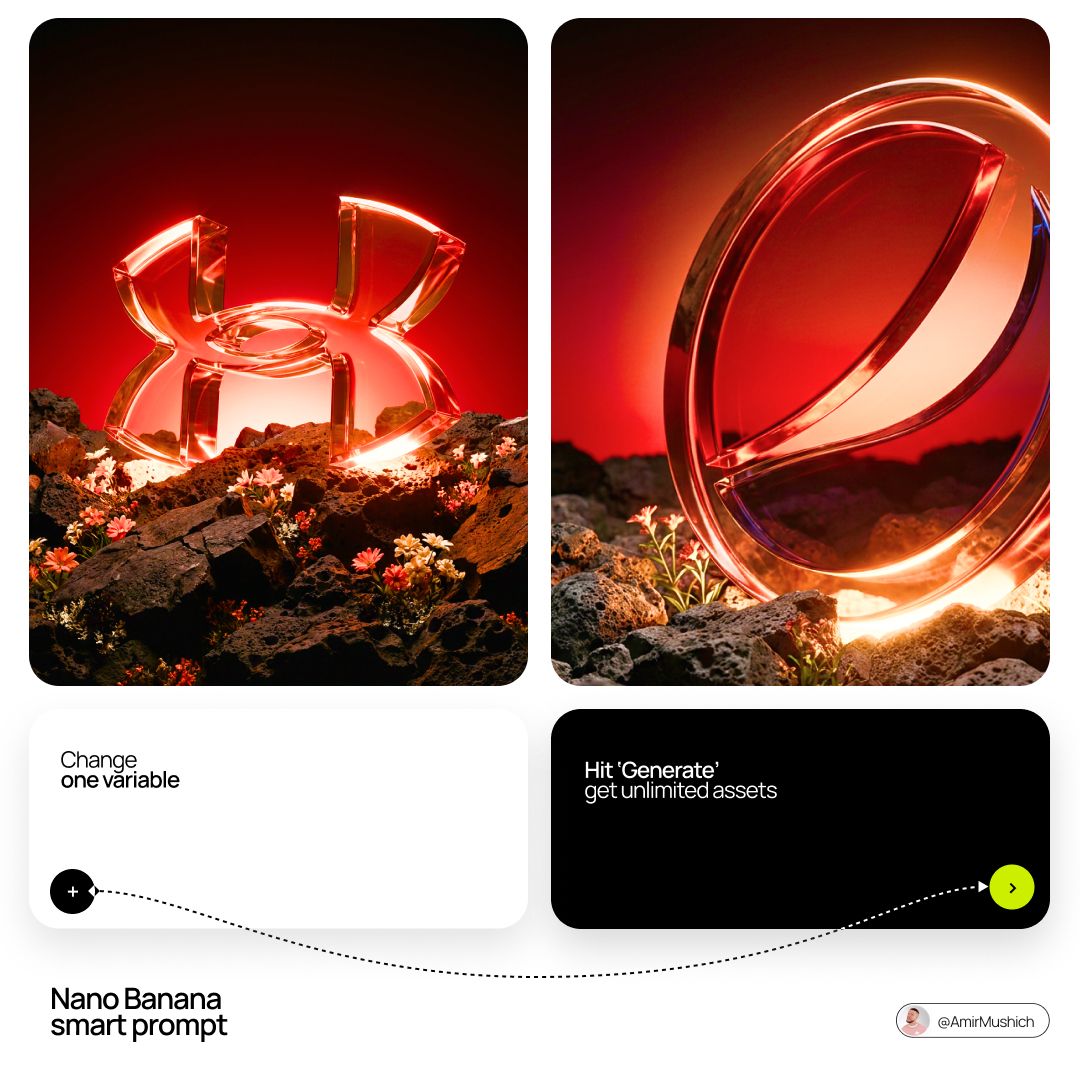
Sculpture de logo en verre sur roche volcanique prompt
Une marque est recréée sous forme de monolithe épais en verre optique posé sur du basalte sombre, éclairé par l'arrière pour briller d'un ambre intense sur un ciel allant du rouge profond au noir. De petites fleurs orange poussent entre les rochers, et le logo semble flotter comme point focal net.

- Modèle
- GPT Image 2
- Type
- Image
- Format d'image
- 1:1
- Partagé
- 3 mai 2026
- J'aime sur X
- 204
Nom de marque
Prompt d'image
5,632 caractères[BRAND NAME] Act as a CGI Art Director and Environment Photographer creating a cinematic hero landscape with a glass logo sculpture emerging from a volcanic rock formation. References: editorial CGI landscape photography, crystal and glass object photography, volcanic terrain macro photography, dramatic sunset landscape cinematography. PHASE 0: BRAND LOGO INTELLIGENCE Retrieve the 100% canonical trademark-accurate primary mark of [BRAND NAME] from training data. Identify the single most iconic reduced form — symbol, monogram, or wordmark. Fidelity test: a brand designer must recognize this as the correct mark. The glass treatment is applied ON TOP of the correct logo geometry — transformation happens after accurate reconstruction, never instead of it. CRITICAL — NO ADDED CONTAINERS: do not add any enclosing shape, circle, oval, badge, or housing around the logo unless that container is part of [BRAND NAME]'s official canonical logo. The glass object is the logo form itself and nothing else. PHASE 1: GLASS LOGO OBJECT — CRITICAL The canonical logo mark of [BRAND NAME] rendered as a solid three-dimensional optical glass sculpture — thick, physical, monumental, with the exact silhouette of the [BRAND NAME] logo. Object depth: 25 to 40% of the logo's total height. All faces polished to sub-micron smoothness. Edges sharp and precise. Bottom cut at a slight bevel — allows the sculpture to stand embedded in rocks below. Tilted backward 5 to 8° — monolithic standing-stone quality. SCENE-INTEGRATED GLASS MATERIAL — CRITICAL: the glass is not a neutral colorless object dropped into the scene. It is a physically accurate optical material that absorbs, refracts, and reflects the scene's ambient color environment, tinted by the red-orange atmospheric environment. Ambient color absorption: warm red-orange volume tint #3A0A00 at 8 to 12% opacity. Transmission color: warm orange-red light. IOR: 1.5 to 1.7. Reflections carry the red gradient of the background and warm orange of the back light. Edge glow warm orange #FF8C00. Internal caustics amber and orange. Overall appearance: a warm amber-tinted luminous crystal that feels native to the volcanic red landscape. PHASE 2: VOLCANIC ROCK GROUND The glass logo stands on and is partially embedded in a formation of volcanic basalt rocks. Dark grey to near-black basalt #1A1A1A to #2D2D2D. Rough, fractured, vesicular surface. Large anchor rocks 15 to 30cm on outer edges, medium rocks 5 to 15cm in the center, small fragments at the base. Lit from behind and below by warm orange back light. Rock formation occupies lower 30 to 35% of frame. PHASE 3: BOTANICAL DETAIL Between rocks: small wild alpine/volcanic flowers — orange, coral, and off-white, 2 to 4cm. 8 to 15 clusters. Thin green stems. Catch the back light as bright orange-lit small forms against dark rock shadows. Patches of dark green or grey-green lichen on rock surfaces. PHASE 4: BACKGROUND & ATMOSPHERE Background: pure atmospheric gradient — deep saturated red-crimson at horizon (#8B0000 to #AA1100) transitioning to absolute black (#000000) at top. No clouds, stars, or details. Most saturated red in lower 30 to 40%. Most intense behind the logo. Perfectly smooth, no texture or noise. PHASE 5: LIGHTING SYSTEM — SCENE AMBIENT DRIVES EVERYTHING Primary back light: warm orange-amber source behind the object at ground level, hidden behind rocks. Color #FF8C00 to #FF6600, high intensity. Passes through the glass creating edge glow and internal caustics, lights rocks and flowers from behind, creates a bright halo on the background behind the logo. Secondary ambient — RED SCENE ATMOSPHERE: the whole scene bathed in red ambient #8B0000 to #AA1100, low intensity, omnidirectional, filling shadows and tinting the glass. Cold top ambient: subtle blue-grey from above, only 3 to 5%. LOGO BASE ACCENT LIGHT — SEPARATION & FOCUS: dedicated light directly below the logo aimed upward. Color #FF9500 to #FFCC00, warmer and more yellow. Intensity 40 to 60% of the back light. Narrow focused upward cone; base brightest, falling off toward the top. Enters through the bevel creating an internal luminous gradient; bottom edges glow in a bright yellow-orange line. Upward caustics cross the downward ones. Lights rocks and flowers beneath the base in a warm amber pool. Separation effect: the logo appears to float and radiate light, commanding full attention as the absolute focal point. PHASE 6: COMPOSITION & CAMERA Aspect ratio: 4:5 portrait. Logo at vertical center — base ~35% from bottom, top ~80%. Rocks in lower 30 to 35%. Camera slightly below the object's midpoint, elevated 5 to 10°, looking very slightly upward, monumental presence. Frontal to the logo, zero horizontal rotation. Slight depth of field. PHASE 7: TECH SPECS Render: Octane or Redshift — physically accurate glass with full caustics and scene-accurate color absorption. Ray tracing: minimum 16 bounces. Glass: dielectric shader, IOR 1.5 to 1.7, transmission 0.95, volume absorption #3A0A00 density 0.08 to 0.12, roughness 0.0. Caustics at maximum. Reflections carry scene colors. Rock: PBR shader, roughness 0.85 to 0.92, vesicular displacement, albedo #1A1A1A to #2D2D2D, metalness 0.0. Background: gradient #AA1100 to #000000. Back light: area light orange #FF7700. Base accent: spot #FF9500 to #FFCC00, 40 to 60%. Red scene ambient: #990000, 15 to 20%. Cold top ambient: blue-grey 3 to 5%. Anti-aliasing maximum. Minimum 2048 samples. No film grain. Output feel: cinematic editorial CGI — a luxury brand film still. The glass must feel like it was born in this volcanic red world, radiating light from within.
Comment l'utiliser
Commencez par remplacer le champ du nom de marque par l'entreprise que vous souhaitez mettre en avant, et vérifiez que le modèle reconstitue son logo officiel plutôt qu'une forme générique. Conservez les consignes d'éclairage et de matériau verre telles quelles : la lumière chaude de contre-jour, le rouge ambiant et la teinte ambrée sont ce qui fait paraître le verre naturel dans ce paysage. Il a été partagé comme prompt GPT Image 2, donc le format 1:1 devra peut-être être recadré rapidement en portrait 4:5 décrit dans le prompt. Idéal pour une bannière principale de marque ou un visuel de lancement.
Partagé publiquement sur X le 3 mai 2026. Tout le mérite de ce prompt et de son résultat revient à son créateur. Ce prompt est le vôtre ? Demandez une mise à jour ou un retrait.