
Prompt εικόνας Branding & UI Προσαρμόσιμα
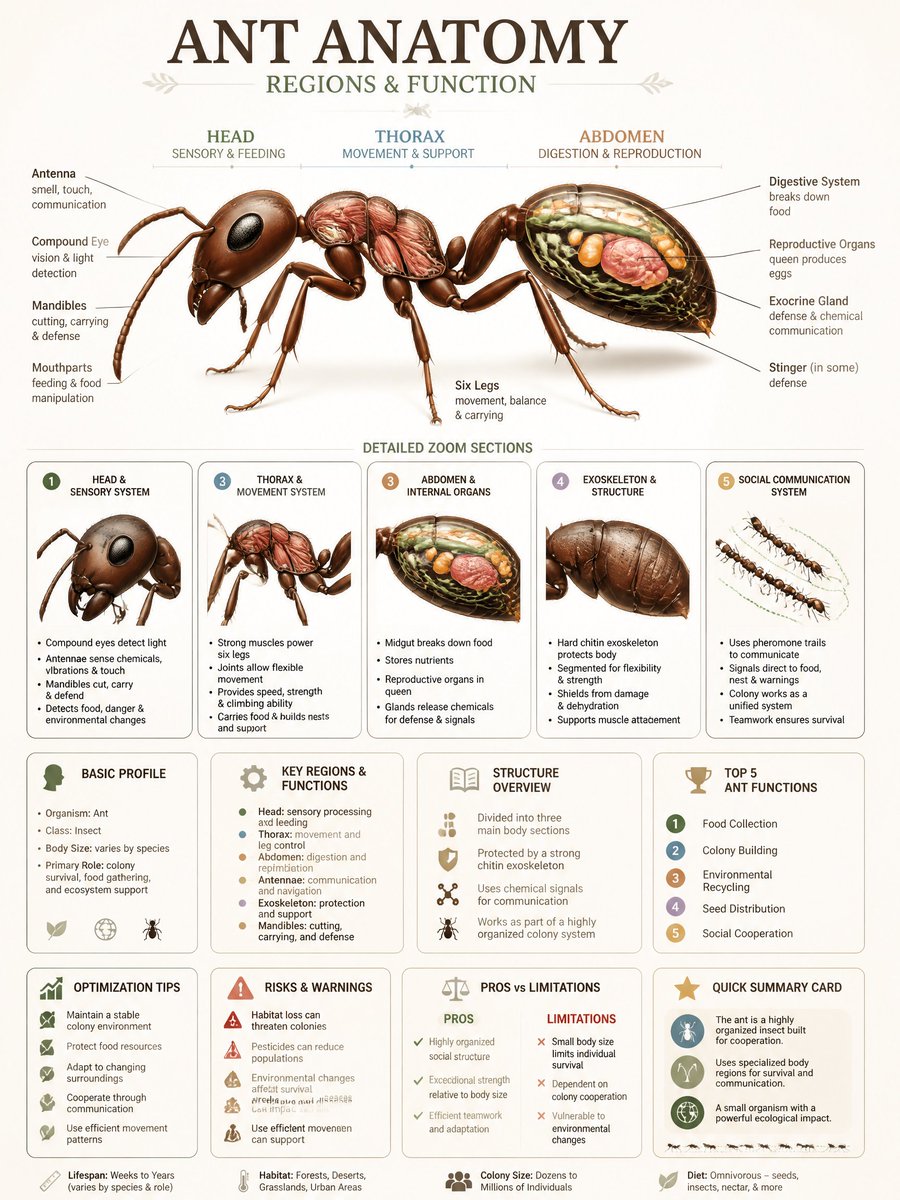
Infographic ανατομίας μυρμηγκιού με μεγεθυσμένα τμήματα σώματος
Ένα κάθετο infographic σε στυλ εγχειριδίου, χτισμένο γύρω από μια λεπτομερή εικόνα μυρμηγκιού, με μεγεθυσμένα πάνελ για το κεφάλι, τον θώρακα, την κοιλία και τον εξωσκελετό. Τα απαλά χωμάτινα χρώματα και οι τακτικές κάρτες δεδομένων κάνουν το έντομο να μοιάζει με συλλεκτικό οδηγό πεδίου.

- Μοντέλο
- GPT Image 2
- Τύπος
- 2 εικόνες
- Αναλογία διαστάσεων
- 3:4
- Κοινοποιήθηκε
- 15 Ιουλ 2026
- Likes στο X
- 201
Τίτλος infographicΌνομα οργανισμού
Prompt εικόνας
4,152 χαρακτήρες{ "type": "image_prompt", "title": "Ant Anatomy Regions & Function", "style": { "overall": "premium natural-history guidebook meets modern editorial infographic", "tone": "educational, refined, collectible, highly structured", "background": "clean light-colored", "palette": "soft, elegant, muted scientific tones (earth browns, warm grays, subtle greens, gentle blues)", "lighting": "gentle shadows, soft highlights", "layout": "vertical, modular, high information density but uncluttered" }, "composition": { "main_subject": { "type": "detailed anatomical illustration", "description": "highly detailed ant with clearly defined body segments, internal organs, legs, antennae, and biological structures", "style": "semi-realistic scientific illustration with soft shading", "placement": "upper-middle focal area", "labels": "major ant regions labeled with fine callouts" }, "zoom_sections": [ { "focus": "head and sensory system", "description": "zoomed-in panel showing compound eyes, antennae, mandibles, communication, and environmental sensing" }, { "focus": "thorax and movement system", "description": "zoomed-in panel showing muscles, six legs, joints, and powerful movement mechanics" }, { "focus": "abdomen and internal organs", "description": "zoomed-in panel showing digestive system, reproductive organs, and defensive functions" }, { "focus": "exoskeleton", "description": "detailed view showing protective outer shell, body segments, and structural strength" }, { "focus": "social communication system", "description": "panel showing pheromone trails, colony communication, and teamwork behavior" } ], "info_panels": [ { "title": "Basic Profile", "content": [ "Organism: Ant", "Class: Insect", "Body Size: varies by species", "Primary Role: colony survival, food gathering, and ecosystem support" ] }, { "title": "Key Regions & Functions", "content": [ "Head: sensory processing and feeding", "Thorax: movement and leg control", "Abdomen: digestion and reproduction", "Antennae: communication and navigation", "Exoskeleton: protection and support", "Mandibles: cutting, carrying, and defense" ] }, { "title": "Structure Overview", "content": [ "Divided into three main body sections", "Protected by a strong chitin exoskeleton", "Uses chemical signals for communication", "Works as part of a highly organized colony system" ] }, { "title": "Top 5 Ant Functions", "content": [ "Food Collection", "Colony Building", "Environmental Recycling", "Seed Distribution", "Social Cooperation" ], "visual_style": "ranked list or icon-based scoring" }, { "title": "Optimization Tips", "content": [ "Maintain a stable colony environment", "Protect food resources", "Adapt to changing surroundings", "Cooperate through communication", "Use efficient movement patterns" ] }, { "title": "Risks & Warnings", "content": [ "Habitat loss can threaten colonies", "Pesticides can reduce populations", "Environmental changes affect survival", "Predators and diseases can impact colonies" ] }, { "title": "Pros vs Limitations", "content": { "pros": [ "Highly organized social structure", "Exceptional strength relative to body size", "Efficient teamwork and adaptation" ], "cons": [ "Small body size limits individual survival", "Dependent on colony cooperation", "Vulnerable to environmental changes" ] } }, { "title": "Quick Summary Card", "content": [ "The ant is a highly organized insect built for cooperation", "Uses specialized body regions for survival and communication", "A small organism with a powerful ecological impact" ], "visual_style": "highlight box with icons" } ] }, "visual_elements": { "icons": "small, refined, minimal scientific icons", "boxes": "rounded corners with subtle borders", "typography": { "title": "large, elegant, high contrast", "subheadings": "clear hierarchy", "body": "clean, readable, compact" }, "connectors": "thin lines linking labels to ant regions", "decor": "subtle grid or editorial alignment guides" }, "design_goals": [ "knowledge integration", "modular information design", "encyclopedia-style clarity", "high readability", "shareable infographic aesthetic", "non-commercial, reference-style presentation" ] }
Πώς να το χρησιμοποιήσετε
Αυτό το prompt λειτουργεί μόνο με κείμενο, οπότε δεν χρειάζεται φωτογραφία. Κοινοποιήθηκε ως prompt για το GPT Image 2. Για να το κάνετε δικό σας, αλλάξτε τη γραμμή τίτλου και τις επικεφαλίδες των καρτών πληροφοριών σε ένα άλλο ζώο ή σε ένα θέμα που σας ενδιαφέρει, όπως οι μέλισσες ή ένα πουλί της αυλής, και διατηρήστε τη δομή των μεγεθυσμένων πάνελ και τη σιωπηλή παλέτα, αφού αυτά δίνουν την εμφάνιση. Το αποτέλεσμα ταιριάζει σε φυλλάδιο μαθήματος βιολογίας, αφίσα τάξης ή εξηγητικό υλικό για κοινοποίηση στα social media.
Σε συλλογέςPrompts για εκπαιδευτικά και επιστημονικά explainers
Κοινοποιήθηκε δημόσια στο X στις 15 Ιουλ 2026. Όλα τα credits για αυτό το prompt και το αποτέλεσμά του ανήκουν στον δημιουργό του. Είναι δικό σας; Ζητήστε ενημέρωση ή αφαίρεση.